| РУССКИЙ |
 |
 |
MSU Frame Rate Conversion Method
MSU Graphics & Media Lab (Video Group)
Algorithm, ideas: Dr. Dmitriy Vatolin
Algorithm, implementaion: Sergey Grishin
See also:
Algorithm allows to double frame rate (fps) of the video stream. This conversion is performed by calculating and inserting the new frames in the stream (see picture).
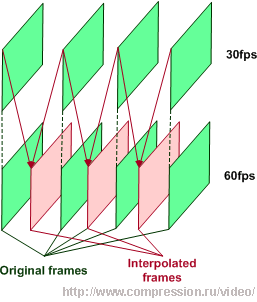
Double up-conversion of the frame rate
The main advantages of the method are:
This is achieved by construction of compensated frames with quarter pixel
accuracy. Such high accuracy is
obtained by using of bilinear and bicubic interpolation. Second advantage
means that interpolated frames
have the same sharpness as the original ones. Note that such the feature is
not common for the
majority of methods of this kind.
Examples
Here we present results of comparison of described (MSU), Frame Repetition (FR) and Linear Interpolation (LI) methods on "akiyo" sequence. Results include PSNR metric visualization of interpolated frames in comparison to original ones on the right side. Following is the color semantics on these images: red color - high difference region, this difference is visually noticeable; yellow - little less than previous difference; green and blue - almost unnoticeable difference; black - no difference.
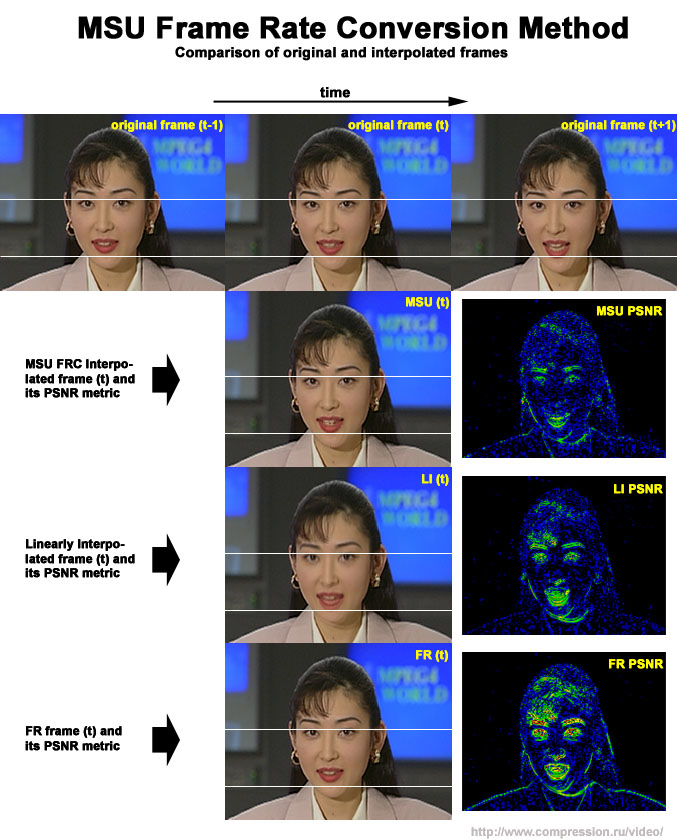
Performance of MSU, LI and FR methods at "akiyo" sequence
On the pictures below there are the frames from sequences with four times increased frame rate. Such the up-conversion is achieved by repeated using of FRC method in accordance to picture:
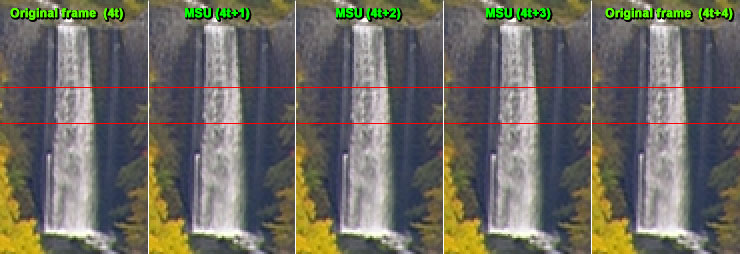
On the next picture there is the comparison of MSU and LI FRC methods by
the example of conversion of "waterfall" sequence:
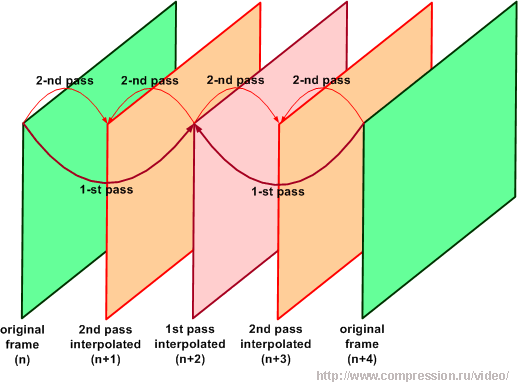
Four times frame rate up-conversion
Quality comparison of MSU, LI and FR methods is shown at the graphs below.
In vertical direction there is PSNR quality level of interpolated frames in
comparison to original ones
(the higher values of metric means the higher quality of interpolated
frames), in horizontal direction
interpolated frame numbers are marked.
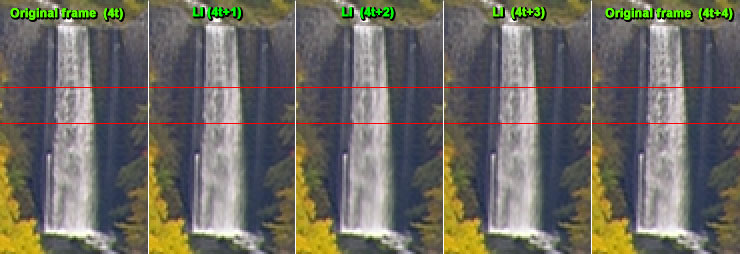
Performance of MSU and LI at "waterfall" sequence
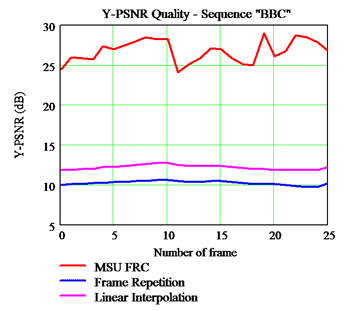
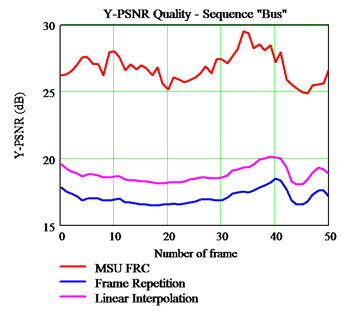
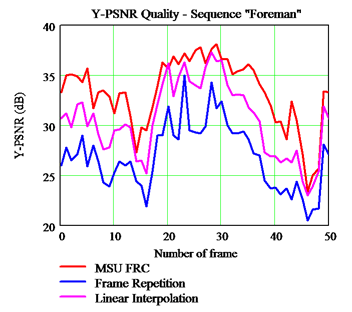 Performance quality of MSU, LI and FR at "BBC", "buc", "foreman" sequences
Below there is a comparison of MSU and UCSD (University of California, San Diego) FRC methods. Sequences with four times increased frame rate were used for this comparison:
On the pictures below it is easy to see the sharpness difference on frames,
which were calculated
by increasing FPS four times:
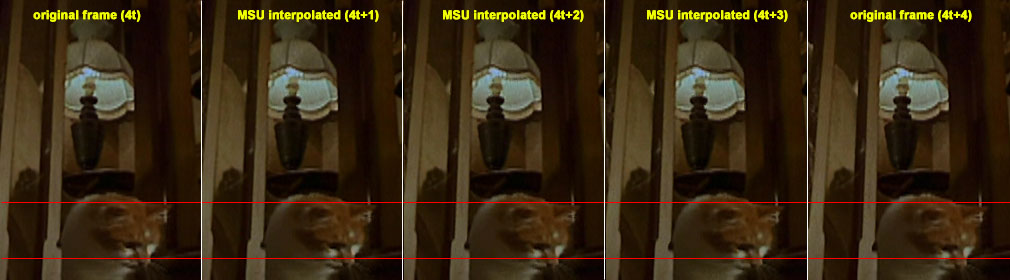
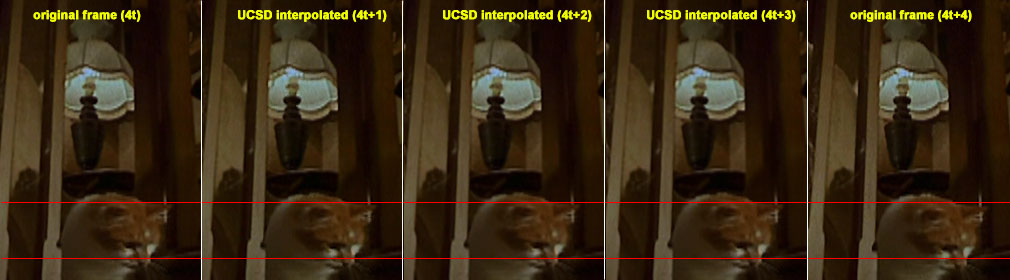
Comparison of MSU and UCSD methods by the example of sequence "dogs"
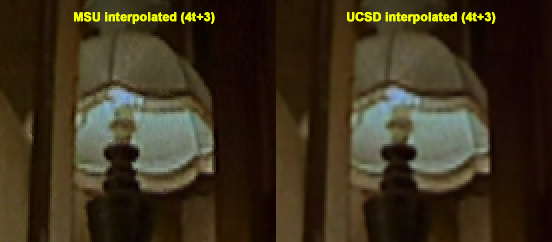
Frames of MSU and UCSD methods for sequence "dogs"
Two sequences where the quality difference of MSU and UCSD methods can be
clearly seen are available for download. In these sequences each frame
contains the same part of frame from sequence processed by FR, MSU and LI.
This method of sequence generation makes comparison of FRC methods easy and
comfortable:
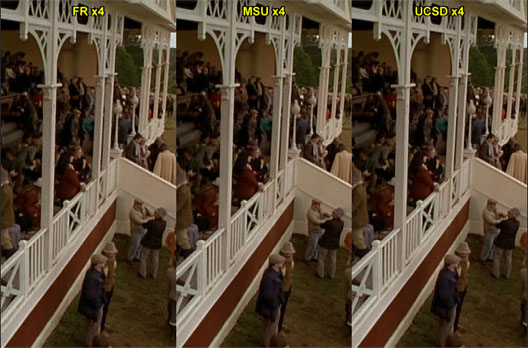
Frame from "crowd" sequence for comparing FR, MSU and LI methods
Download
Filter unavailable due to contract limitation.You can license Advanced FRC Project result.
- Sequence "dogs" for comparing FR, MSU and UCSD (704x464, Divx 4.12, 2.1 Mb)
- Sequence "crowd" for comparing FR, MSU and UCSD (704x464, Divx 4.12, 2.6 Mb)
| E-mail: |  |
- New FRC project: Advanced FRC Project
- Public FRC filter: MSU Frame Rate Conversion
Another resources
Video resources:
Server size: 8069 files, 1215Mb (Server statistics)
Project updated by
Server Team and
MSU Video Group
Project sponsored by YUVsoft Corp.
Project supported by MSU Graphics & Media Lab