| RUSSIAN VERSION HERE! |
MSU MPEG-4 SP/ASP
Codecs Comparison
For professional users and codec authors
MSU Graphics & Media Lab (Video Group)
Project head: Dr. Dmitriy Vatolin
Testing, charts, analysis: Dmitriy Kulikov, Alexander Parshin
Translating: Daria Kalinkina
Verification: Stanislav Soldatov
About comparison
Tested codecs:
- DivX 5.2.1
- DivX 4.12
- DivX 3.22
- MS MPEG-4 3688 v3
- XviD 1.0.3
- 3ivx D4 4.5.1
- OpenDivX 0.3
Main goals of the MPEG-4 SP/ASP testing
The main idea is to compare the results provided by the
newest versions of MPEG-4 codecs when they are used by an ordinary user
for home video compression. As a rule, such users
prefer simple and popular programs to play DVD movies or digitize signal from
tuner. Also they rarely change codec's default settings. So used
default codecs settings in our comparison varying only the bitrate value.
Another goal of this testing was to trace the evolution of the DivX codec.
Three versions of this codec took part in the testing: DivX 5.2.1, DivX 4.12,
DivX 3.22.
The testing also illustrates the usage of two additional options in DivX
5.2.1: GMC (Global Motion Compensation) and Quarter Pixel, that were
announced to improve quality on some video sequences. Main parts
of the comparison:
- Comparison in Y-PSNR, U-PSNR and V-PSNR metrics.
- Per frame comparison.
- Bitrate handling (does your movie fit on the CD?).
- Visual comparison.
- Informal codecs comparison.
Comparison with PSNR metric
PSNR - is a metric used to compare two pictures: the more per pixel difference between the pictures is the less is PSNR value. We use the logarithm of the average value of the per frame PSNR metric to compare two sequences. So the higher is the codec's line on the graph the better is the quality of compression performed by this codec. Y-PSNR is the difference in brightness component, U-PSNR and V-PSNR are the differences in hue components.
The diagram below clearly demonstrates the advantage of DivX 5.2.1 over XviD 1.0.3.
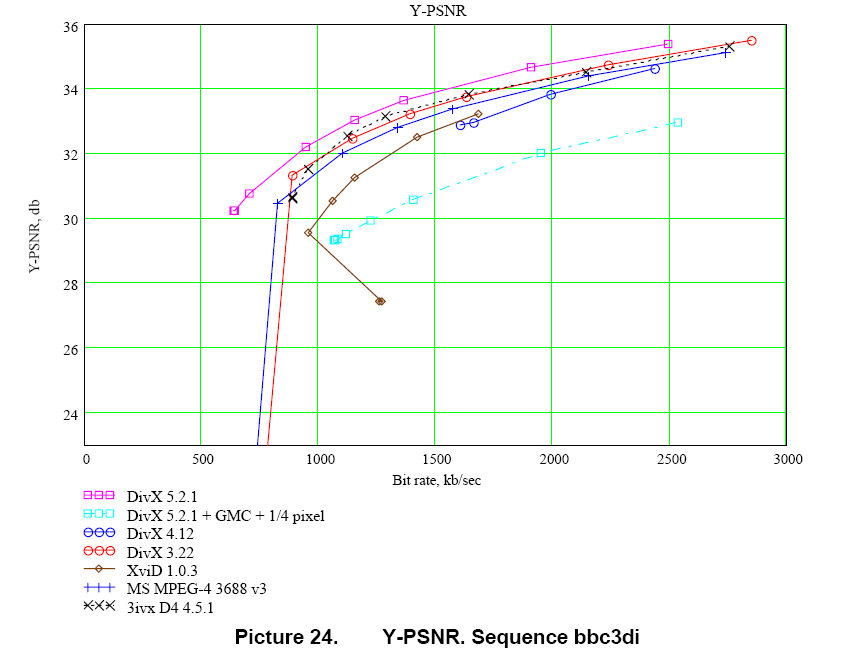
On this picture Y-PSNR values are shown. The higher is the line the
better is the quality.
Visual codec comparison
In most cases the PSNR value is in accordance with the compression quality. But sometimes this metric does not reflect presence of some important visual artefacts. For example, we cannot estimate the quality of the blocking artefacts compensation performed by some codec or detect the presence of the "snow" artefacts (strong flicking of the stand-alone pixels) in the compressed video using only PSNR metric. Also in some cases it is difficult to say whether 2 dB difference is significant or not.
That is why we use visual comparison of some frames in addition to the PSNR graphics. This will not help us to understand the whole situation, but will allow to demonstrate some interesting features of the codec (e.g. block artifacts compensation).
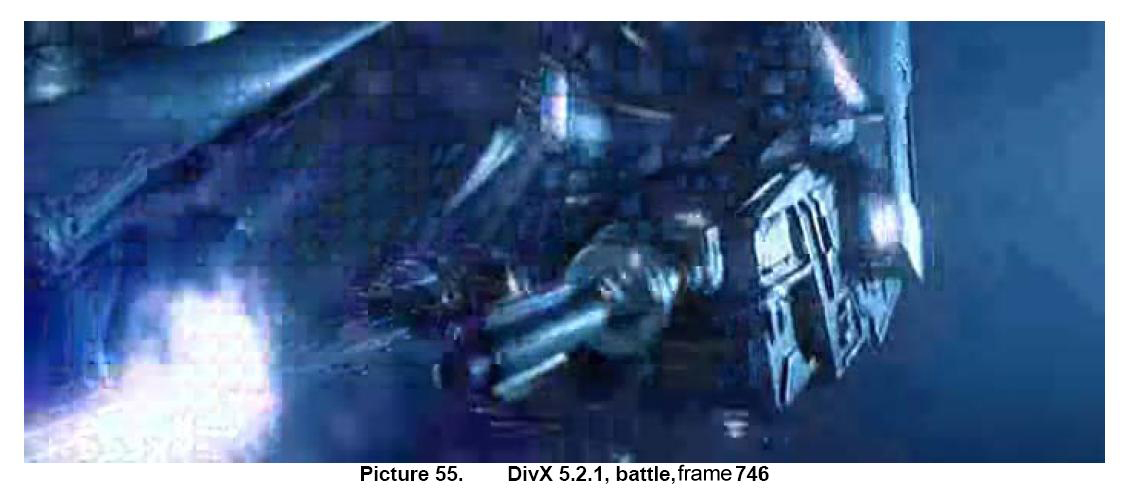
DivX 5.2.1
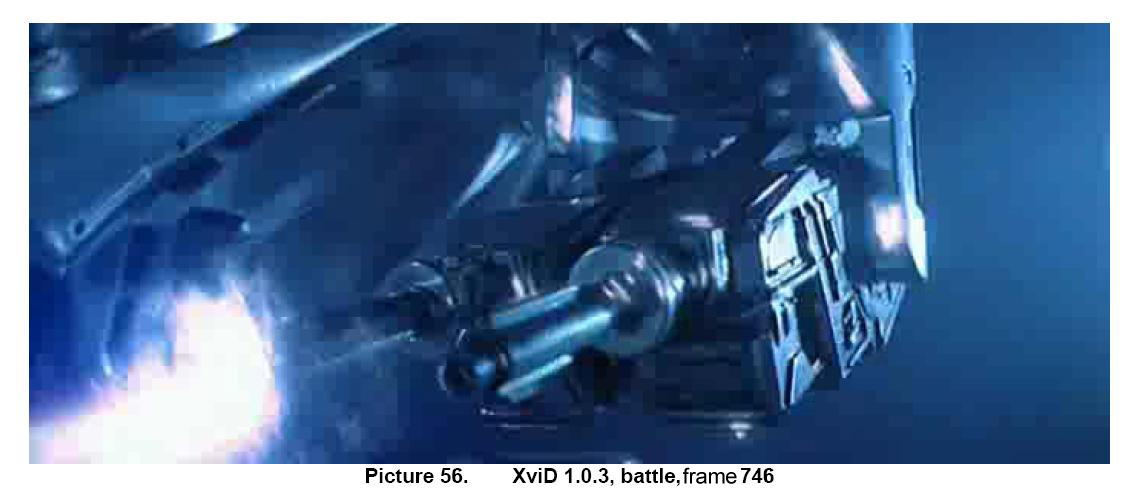
XviD 1.0.3
These pictures present the same
frame compressed by two different codecs with the same bitrate. One can see
that the frame from the sequence compressed by XviD 1.0.3 has much
better quality.
Informal codecs comparison
Different codecs show significantly different results on different sequences. That happens because of all represented sequences have different character (motion, noise e.t.c.). This fact allows to define which codecs do well with any kind of video sequences and which provide good results only for some class of sequences. But all the diagrams do not answer the question whether there is a leader among these codecs which could be used for compression of most types of video. In order to find out general characteristics of each codec on the whole testing set we give different scores to the codecs according to some special rules and place the results in a table. The more scores some codec gets the better it is.
Download
- MSU MPEG-4 SP/ASP Codecs Comparison - PDF (7.63 Mb)
- MSU MPEG-4 SP/ASP Codecs Comparison - ZIP (6.1 Mb)
| E-mail: |  |
MSU video codecs comparisons resources:
- Introduction to Video Codecs Comparison
- Lossless Video Codecs Comparison 2004 (October 2004)
- MPEG-4 SP/ASP Video Codecs Comparison (March 2005)
- JPEG 2000 Image Codecs Comparison (September 2005)
- First Annual MPEG-4 AVC/ H.264 Video Codecs Comparison (January 2005)
- Second Annual MPEG-4 AVC/H.264 Video Codec Comparison (December 2005)
- Subjective Comparison of Modern Video Codecs (February 2006)
- MPEG-2 Video Decoders Comparison (May 2006)
- WMP and JPEG2000 Comparison (October 2006)
- Third Annual MPEG-4 AVC/H.264 Comparison (December 2006) (All versions for free!)
- Lossless Video Codecs Comparison 2007 (March 2007)
- Fourth Annual MPEG-4 AVC/H.264 Comparison (December 2007) (All versions for free!)
- Options Analysis of MPEG-4 AVC/H.264 Codec x264 (December 2008)
- Fifth MPEG-4 AVC/H.264 Comparison (May 2009) (All versions for free!)
- Sixth MPEG-4 AVC/H.264 Comparison (May 2010)
- Seventh MPEG-4 AVC/H.264 Comparison (May 2011)
- Eighth MPEG-4 AVC/H.264 Comparison (May 2012)
- Ninth MPEG-4 AVC/H.264 Comparison (Dec 2013)
- Tenth Video Codec Comparison (HEVC) (Oct 2015)
- Eleventh Video Codec Comparison (HEVC) (Aug 2016)
- Twelfth Video Codec Comparison (HEVC) (Aug 2017)
- Thirteen Video Codec Comparison (HEVC) (Aug 2018)
- Fourteen Video Codec Comparison (HEVC) (Sept 2019)
- Cloud Encoding Servoces Comparison 2019 (Dec 2019)
- Fifteen Video Codec Comparison (HEVC) (Dec 2020)
- Sixteen Video Codec Comparison (Dec 2021)
- Seventeen Video Codecs Comparisons (Nov 2022)
- Eighteenth Video Codecs Comparisons (Apr 2025)
- Nineteenth Video Codecs Comparisons (2025)
- Codec Analysis for Companies:
Other materials
Video resources:
Server size: 8069 files, 1215Mb (Server statistics)
Project updated by
Server Team and
MSU Video Group
Project sponsored by YUVsoft Corp.
Project supported by MSU Graphics & Media Lab